

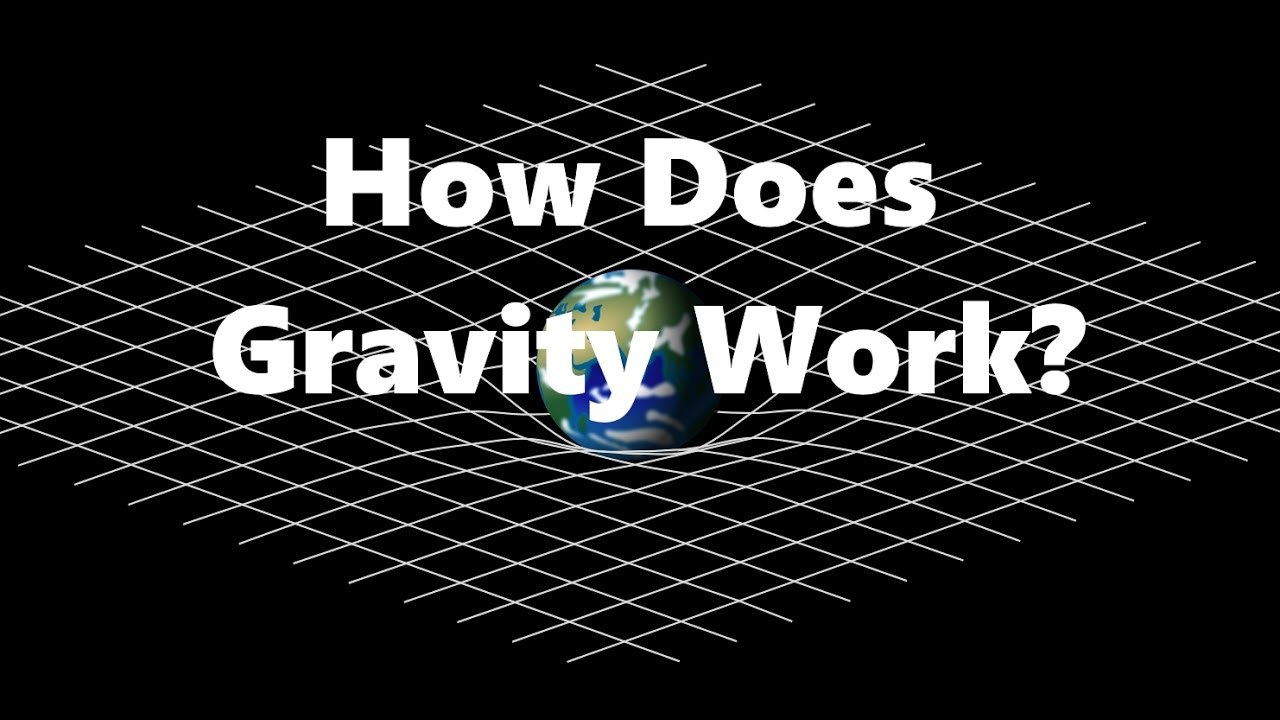
Gravity is the invisible ‘glue’ that shapes the Universe. Our understanding of it has evolved from a simple pulling force to a fundamental warping of the very fabric of reality.
1. The Classical View — Newton’s Pull
In the 1680s, Isaac Newton proposed that gravity is an attractive force between any two objects with mass.
- Mass matters: The more massive an object is, the stronger its gravitational pull.
- Distance matters: The further apart two objects are, the weaker the pull becomes. This follows the inverse-square law — meaning if you double the distance, the gravity drops to one-fourth.
- Universal reach: This same force makes an apple fall to Earth, keeps the Moon in orbit, and keeps the planets circling the Sun.
2. The Modern View — Einstein’s Curve
In 1915, Albert Einstein revolutionized physics by suggesting gravity isn’t a force at all, but a distortion of spacetime.
- The fabric of space: Imagine space and time as a flexible fabric. A massive object like a star sits on this fabric and creates a ‘dip’ or ‘curve’.
- The ‘straight’ path: Smaller objects don’t get pulled; they simply follow the curves in the fabric. A planet orbits a star because it is rolling along the curved space created by the star’s mass.
- Bending light: Because gravity curves space itself, even massless light follows these curves — a phenomenon called gravitational lensing.
3. Cosmic Effects of Gravity
Gravity is responsible for the largest structures in the Universe:
- Star and planet formation: It pulls together clouds of gas and dust until they become dense enough to ignite into stars or coalesce into planets.
- Black holes: These are regions where mass is so concentrated that the spacetime curve becomes a ‘bottomless pit’ from which not even light can escape.
- Tides: The Moon’s gravity pulls on Earth’s oceans, causing them to bulge and create daily tides.
- Time dilation: Gravity even affects time. According to General Relativity, time actually moves slower in stronger gravitational fields compared to weaker ones.
4. The Unsolved Mystery
While we can measure and predict gravity with incredible accuracy, it remains the weakest of the four fundamental forces. Scientists are still searching for a ‘Theory of Everything’ to explain how gravity works at the quantum level — specifically looking for a hypothetical particle called the graviton.
Newton: Gravity is a force — objects with mass pull on each other across distance.
>
Einstein: Gravity is geometry — mass warps spacetime, and objects follow the curves.
Conclusion
Gravity is best described today as curvature of spacetime (Einstein), not a simple pull (Newton). It shapes the cosmos, bends light, and slows time; at the quantum scale it remains unexplained, driving the search for a unified theory and particles such as the graviton.


Leave a comment